
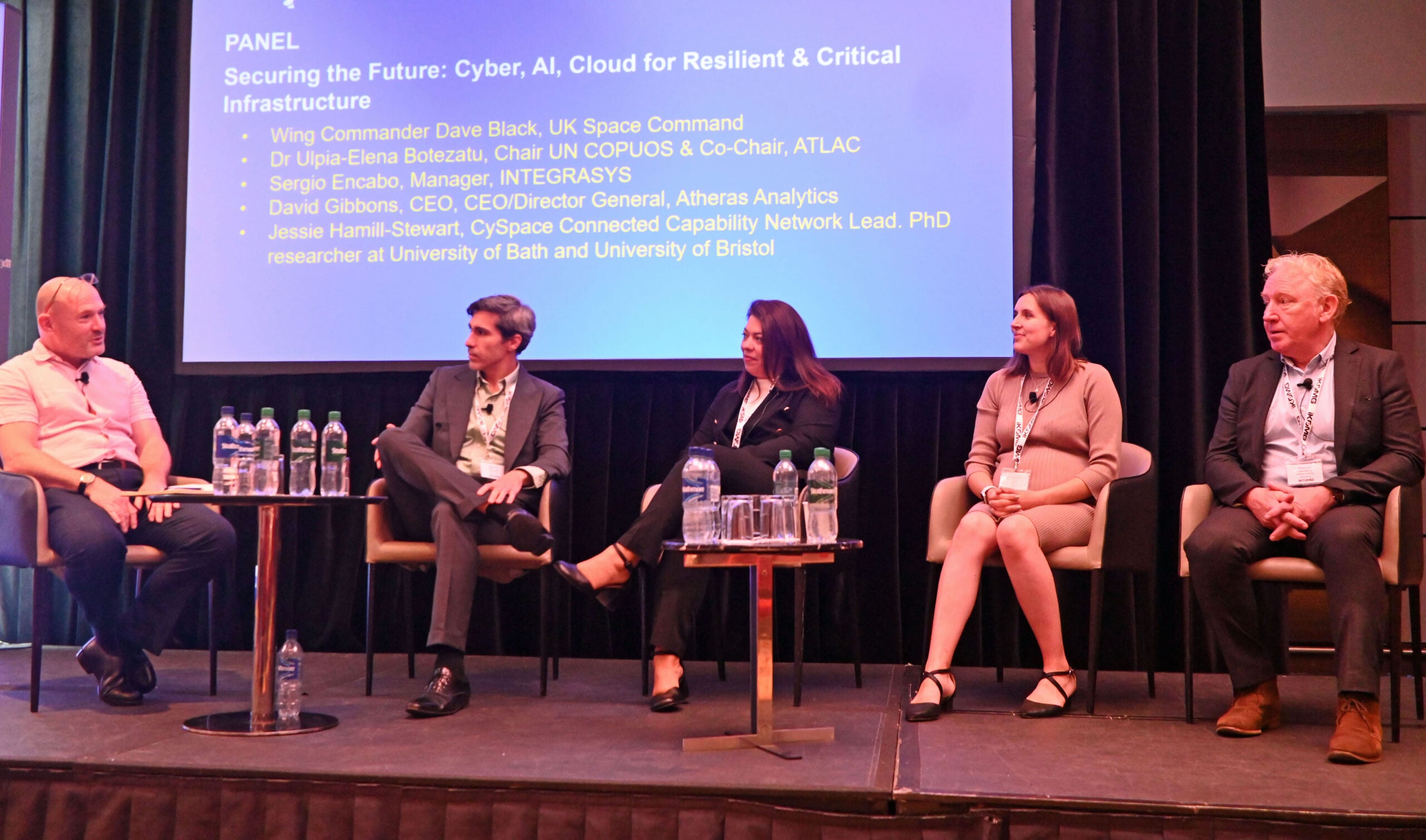
The Strategies in Satellite Ground Segment event in London. Photo: Via Satellite
Improving regulations, information-sharing, and a deeper understanding of AI will be important as satellite companies look to be better prepared for cyber attacks. Industry experts discussed securing critical infrastructure at the Strategies in Satellite Ground Segment event in London earlier this month, where UK Space Command Wing Commander Dave Black said the bad actors are looking for a way in to space-based networks and assets.
“As we start to integrate with 5G/6G networks, and you add AI on top of that, the attack surface is growing and growing all the time. It is going beyond state actors into a wider threat group,” Black said.
Sergio Encabo, manager for Integrasys, detailed there are now a range of different threats, and ones that are looking to attack and disrupt supply chains in satellite.
He added, “UHF is vulnerable to jamming attacks. AI can help the process and speed up things when analyzing the threats. We are using AI for monitoring and detecting threats. AI is here, will remain here. It will help more. But it is important to remember that satellite jamming will be part of cyber threats on space assets.
Much of the discussion centered on the impact of AI both from an offensive and defensive point of the view. David Gibbons, CEO of ground tech company Atheras Analytics, sees the cyber threat related to AI as all about human action, like previous tech introductions. Atheras Analytics has developed a suite of AI-based software tools that enable satellite operators to optimize the design and operation of their Ka-band and Q/V-band satellite networks for greater network availability.
“AI as an aid [and] tool is something we can work with. We have had similar concerns about software developments before. AI itself is not the danger; human beings are the danger. It was the same five to 10 years ago when new network management systems came in. It is always the human element,” Gibbons said.
Gibbons spoke of the fact that what companies like Atheras Analytics are trying to do is to help develop the infrastructure where everything is integrated. He talked of AI enabling an integrated world where autonomous vehicles and ships work seamlessly, using different types of connectivity.
He added, “We are going to move away from a ‘space’ ecosystem to an overall ecosystem in which space is a part of. AI is a big step change here.”
Jessie Hamill-Stewart, CySpace Connected Capability Network Lead, and PhD researcher at University of Bath and University of Bristol said that space technology has always involved automation, AI algorithms are now allowing data to be processed much faster, transforming what can be done to secure space.
But there is a flipside. “It also introduces additional vulnerabilities. It poses its own set of threats, worries and concerns. AI can help write very convincing phishing emails, as well as malicious code. There is this concern, no matter what the ways in which defense can be aided with AI, attackers will use it in a similar way,” Hamill-Stewart said. “There is a concern if we become too dependent on AI, we miss little things/signs that humans will be able to pick up on.”
Hamill-Stewart believes one of the keys to better security space is information sharing, and companies in space being better aware of the threats. She encouraged developing more trust within the space sector to share information and develop mitigations.
With space becoming more part of the mainstream and part of an overall communications ecosystem, Hamill-Stewart admits that the stakes are now “too high” to ignore security and not implement it in a full and complete way. She said, “We are becoming more dependent on space. It makes it even more important to secure it.”
Dr. Ulpia-Elena Botezatu, chair of the United Nations Committee on the Peaceful Uses of Outer Space (COPUOS) Scientific and Technical Subcommittee (STS), and co-chair of the Action Team on Lunar Activities Consultation (ATLAC), spoke more about regulation in this area.
Botezatu worked on a paper that took some critical elements of cybersecurity policy and looked at how it could be introduced into space policy and found there was not much convergence between space and cybersecurity.
“There is a lot of work to be done to manage all of these domains to connect them to one another,” Botezatu said. “Space has become much more an operational domain. It is quite different from air, land, maritime. Space is integrating everything together so it needs to be treated differently.”
The post Preparing the Ground to Repel Cyber Attacks appeared first on Via Satellite.